More Stories
Back to Blog

USDT vs USDC in the UAE: Which Stablecoin for P2P?
Team BlockX
September 5, 2026
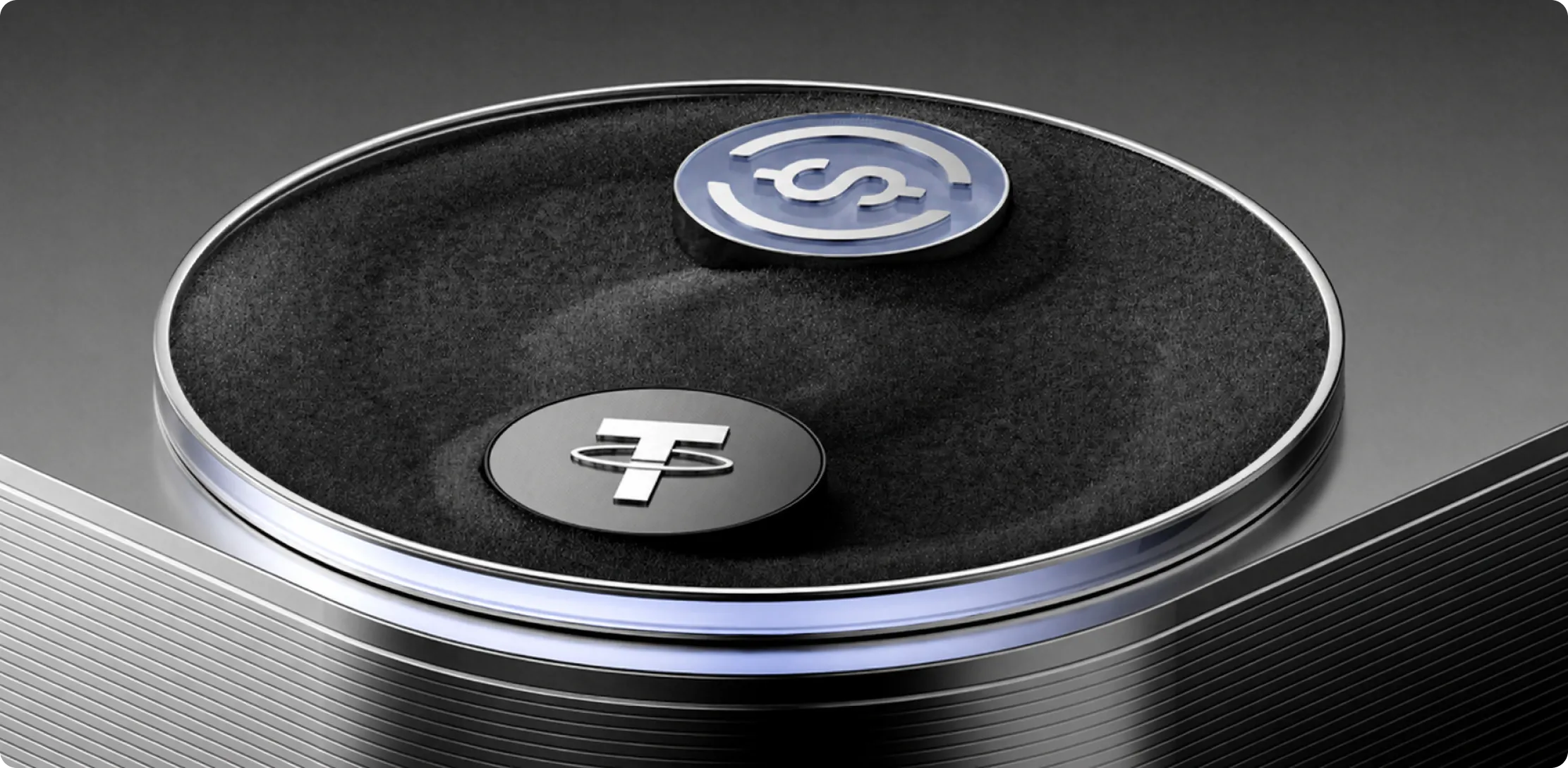

Both are tokens that aim to hold a value of one US dollar, issued by a company that says it holds reserve assets to match every token in circulation. Neither is a dollar in a bank account, and neither is deposit-insured. The peg is a claim about the issuer's balance sheet, and it is only as good as that balance sheet and the issuer's willingness to redeem.
Tether issues USDT, which has been in circulation since 2014 and is the most widely traded stablecoin by volume. Circle issues USDC, which launched in 2018 and has generally positioned itself around regulatory engagement and disclosure.
The most useful comparison is not "which is safer" in the abstract, but what each issuer commits to publishing, since that is what a reader can actually verify.
Circle states that USDC is backed entirely by cash and cash-equivalent assets, with the majority held in the Circle Reserve Fund, a government money market fund managed by BlackRock that holds cash, short-dated US Treasuries and overnight Treasury repurchase agreements. The remainder sits as cash at large banks. Circle publishes monthly third-party assurance reports prepared under AICPA attestation standards, and discloses reserve holdings weekly alongside mint and burn flows.
Tether states that its tokens are pegged one-to-one with a matching fiat currency and backed one hundred per cent by its reserves, and publishes figures on tokens in circulation. What it has not published is a completed full financial audit. Its disclosures take the form of periodic attestation reports rather than an audit, and its reserves have historically included assets beyond cash and short-term government debt.
An attestation and an audit are not the same thing. An attestation reports agreed figures at a point in time; a full audit examines the controls and records behind them. Both issuers publish attestations. Only one has committed to the audit path.
This is where the UAE picture diverges from most international comparisons.
The Central Bank of the UAE issued its Payment Token Services Regulation as Circular 2/2024, dated 7 June 2024. Article (2)7 is the provision that matters here. It states that no merchant or other person in the UAE selling goods or services in the course of business may accept a virtual asset towards payment for that sale unless the asset is either a dirham payment token issued by a licensed payment token issuer, or a foreign payment token issued by a registered foreign payment token issuer being used to buy a virtual asset or a virtual-asset derivative.
Read plainly: a shop in Dubai cannot take USDT for a coffee. The only foreign tokens that get through that door are ones whose issuer has registered with the Central Bank, and even then only for buying virtual assets rather than ordinary goods.
In 2025 Universal Digital's USDU became the first foreign payment token issuer registered under that regime. USDT and USDC do not hold that registration. They remain widely traded in the UAE for buying and selling crypto; what they are not is an approved way to pay a merchant for goods or services on the mainland.
Article (2)13 puts the financial free zones outside all of this: references to “the UAE” in that article exclude them. Activity inside ADGM or DIFC is governed by their own regimes and the answer there can differ.
USDT is the more commonly quoted stablecoin on P2P venues in the region; USDC appears less often. Whichever coin has deeper local liquidity at the moment you trade will usually carry a narrower spread against the dirham and offer a wider choice of counterparties. A stronger reserve profile does not help if nobody is quoting the other side of the trade, so it is worth checking both books rather than assuming.
Which network should you send it on? Fees for the same USDT transfer differ by a factor of hundreds between networks — see The Cheapest Network to Send USDT in 2026: TRON vs Solana vs Base.
For holding a dollar balance where disclosure quality matters most, USDC publishes more, more often, and under a stricter framework. For moving in and out of dirhams through regional P2P markets, USDT is more commonly quoted, and available liquidity is what determines the price actually paid.
Neither is an approved means of payment for goods and services on the UAE mainland, and that is a regulatory fact rather than a comment on either issuer.
This article is general information about how these instruments work, not financial, tax or legal advice. Stablecoins carry issuer and market risk, and their value can move away from the peg.



.png)
Copyright © 2026
BlockX. All Right Reserved.

BlockX Digital Inc. is a technology infrastructure company. BlockX does not provide financial services, investment advice, or act as a money transmitter. Nothing on this website constitutes a financial product offer or solicitation.
